Bulking means consuming more calories than you strictly need at your maintenance level. You therefore create a calorie surplus. But how large should that be if you’re aiming for maximum gains?
1. Bulking in natural bodybuilding means eating slightly more than your maintenance level, but certainly no more than a few hundred calories. This is also called lean bulking.
2 Some naturals can even achieve muscle growth with a (small) calorie deficit while simultaneously losing fat. This is called body recomposition (recompensing). In practice, it only works for beginning strength athletes and/or those who are significantly overweight.
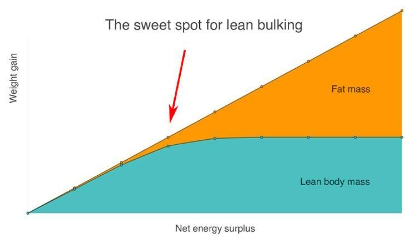
3. Throughout your bodybuilding career, it becomes increasingly difficult to achieve muscle growth. As a result, you require a smaller calorie surplus, ultimately reaching approximately 100 to 200 calories. After a very small energy surplus, most of the extra calories are stored as fat, with little to no increase in muscle mass.
4. The advice for beginners is a calorie surplus of 15-20% of the maintenance level (~400-500 kcal), for intermediates 10-15% of the maintenance level (~200-300 kcal), for advanced users 5-10% of the maintenance level (~100-200 kcal).
MISUNDERSTANDINGS
First of all: the term “bulking” is misleading because it suggests you should eat as much as you can. While this is essentially true for steroid bodybuilding, natural bodybuilding is a completely different profession. If you start gorging yourself as a natural, you’ll quickly develop flabby fat mass instead of rock-solid muscle mass.
Another misconception is that you have to bulk to build muscle mass. That’s not true: even if you eat around maintenance levels or even maintain a calorie deficit, you can still build muscle mass. In the latter case, you’ll also lose some fat, thus stimulating muscle growth and fat loss simultaneously, also known as body recomposition. A 2021 meta-study shows that you can still achieve muscle growth with a calorie deficit of 200 to 300 kcal. Only from a deficit of 500 kcal does muscle growth become very difficult, if not impossible.
Body recomposition is particularly feasible for beginners and individuals with a high body fat percentage. However, body recomposition is also sometimes possible for more experienced and/or lean strength athletes.
RESEARCH
What if you’re aiming for maximum muscle growth and aren’t afraid of a little fat mass? That’s where bulking comes in. So you’re eating slightly above your maintenance level, but how much exactly?
ARAGON/SCHOENFELD
A 2020 review by muscle growth specialists Alan Aragon and Brad Schoenfeld states that beginner and intermediate natural bodybuilders (0-3 years of serious training) should consume approximately 20 to 40% above their maintenance intake to optimize muscle growth. In practice, this usually equates to 500-1000 kcal.
Muscle gains are likely greatest when the surplus is primarily derived from carbohydrates, according to this review. Carbohydrates are the primary energy source for strength training. In addition, the surplus should consist of 20-40 grams of protein, or 0.4 g/kg body weight.
Advanced natural bodybuilders can get by with a smaller calorie surplus, as they have less growth potential. As an advanced athlete, you’ve already achieved most of your gains and will have to settle for very slow muscle growth. According to Aragon and Schoenfeld, this requires a modest calorie surplus of 10-20%, or usually 250-500 kcal. This surplus is best achieved primarily from protein, also 20-40 grams, or 0.4 g/kg body weight, and therefore relatively few additional carbohydrates.
Recompen seems to be reserved for beginners only. Schoenfeld:
As you become more trained, it becomes increasingly difficult to recomp. If your goal is maximum muscle mass, you’ll need to gain some body fat in the process.
ROZENEK ET AL.
A 2002 study also shows that beginners benefit most from a large calorie surplus. The young, beginning strength athletes in this study consumed approximately 400 to 500 kcal above maintenance. They gained very little fat, but did see a significant increase in lean body mass.
According to coach Eric Helms, this shows that young, beginner strength athletes with relatively normative body fat percentages can benefit from fairly aggressive bulking levels of around 500 kcal, as long as they train hard and pursue progressive overload.
Beginners are simply the most sensitive to growth stimuli from training. This is also where the term “newbie gains” comes from.
HELMS ET AL.
A 2023 study by the same Eric Helms, conducted among experienced strength athletes, shows that there’s little difference between a small (5%) and a higher (15%) surplus. However, with a high surplus, significantly more fat is stored. According to coach Steve Hall of Revive Stronger, you should therefore aim for a weight gain of 0.25 to 0.5 grams per kilogram of body weight per week with your surplus.
Coach Menno Henselmans says in response to this study:
You will get the best results by monitoring your progress (strength, body composition and weight gain) and adjusting your energy intake accordingly to ensure you gain primarily lean body mass.
GARTHE ET AL.
A 2013 study by Garthe et al. shows that a calorie surplus causes little or no additional muscle growth and strength gain, but does cause additional fat mass.
For this study, 38 elite athletes were followed during an off-season bulking diet. One group maintained their usual diet. The other group was instructed to add approximately 500 kcal to their diet. Both groups continued their usual training with four strength training sessions and an intense 17 hours of sport-specific training per week.
After about 10 weeks, there were no significant differences between the groups in their gains in lean body mass (FFM), strength, or power. The 500 extra calories only resulted in significantly more fat gain.
Coach Henselmans concludes from this study:
The message for natural bodybuilders is clear: lean bulking is the way to go. Traditional dirty bulking quickly turns into dream bulk.
Learn more about lean bulking in this podcast.
SANCHEZ ET AL.
Finally, a more recent study in which one group of strength-trained athletes maintained a 3% energy surplus, while the other group consumed a 10% surplus for ten weeks. Both groups included men and women who consumed 1.6 g/kg/day of protein and trained three times a week at a high volume.
The finding? The higher energy surplus group gained significantly more body fat (1.9 vs. 0.4 kg), according to DXA scans, but not significantly more lean body mass (1.9 vs. 1.3 kg) or 1RM strength during their squats or bench presses.
Coach Henselmans concludes from this study, and repeats himself:
Natural strength athletes who have passed the beginner stage should keep their bulking phases lean for optimal nutrient distribution. After a very small energy surplus, most of the extra calories are stored as fat, with little or no increase in muscle mass.
ADVICE
How many calories should you consume for maximum muscle growth with minimal fat gain? You should adjust your diet based on your experience level and therefore your sensitivity to muscle growth.
Based on the studies discussed and the practical experience of renowned coaches, we arrive at the following recommendations:
- Beginners: 15-20% of maintenance level (~400-500 kcal);
- Intermediates: 10-15% of maintenance level (~200-300 kcal);
- Advanced: 5-10% of maintenance level (~100-200 kcal).
If you want to gain muscle mass and lose fat at the same time (‘recomping’), eat around maintenance or slightly below it (200-300 kcal).
Tracking your body weight can help you see if you’re eating enough or too little. However, the only truly accurate way to track your calorie intake is with a calorie app.